Using Explosive Weapons, Warring Parties ‘Committing War Crimes’ in DR Congo
Amnesty International reports that both the Congolese army and the M23 Movement, an armed group claiming to defend ethnic Tutsis, have used explosive weapons, killing over 100 civilians in the space of 6 months.
Listen to this story

20 Jan 2025
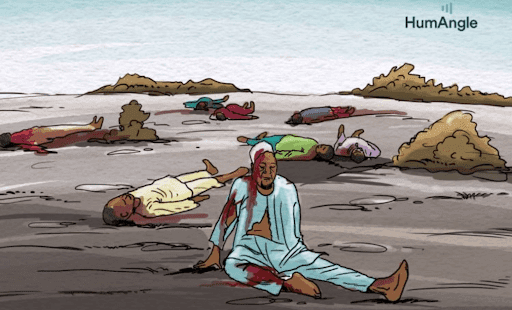
Violating extant humanitarian laws, warring parties in the ongoing conflict in the Democratic Republic of Congo (DR Congo) are using explosive weapons in densely populated areas, killing more than 100 civilians and wounding many others.
Amnesty International, a global human rights organisation, reported that between January and July 2024 alone, more than 150 attacks involving explosive devices with broad range impact were recorded.
According to a report by the human rights organisation, both the Congolese army and the M23 Movement, an armed group claiming to defend ethnic Tutsis, were accused of using “inherently inaccurate” weapons. The M23 fighters resurged in 2021, with the support of thousands of Rwandan soldiers, triggering a massive humanitarian crisis in many parts of DR Congo.
“This escalation in the use of armed explosives is a serious threat to civilians in a conflict which since the past three decades has been marked by systematic violations of human rights,” said Agnes Callamard, Secretary General of Amnesty International.
Research by Amnesty International, based on 60 eyewitness accounts and photo and video analysis, revealed the use of 122 mm Grad rockets and other unprecise arm systems. These arms, fired by M23 and the Congolese army, have hit residential quarters, displaced persons camps and urban areas, causing massive loss of civilian lives.
During an attack on January 25, 2024, in Mweso, located in North Kivu, a strike attributed to Congolese soldiers destroyed a house, killing 19 civilians, 15 of whom were children, and wounded 25 others. Amnesty International says it found no military targets within the proximity of the area. Also, on March 4, 2024, a strike on a group of civilians escaping from Nyanzale was attributed to the M23 rebels, killing 17 persons among whom were children.
Since January 2024, the M23, with the support of the Rwandan Defense Forces (RDF) has intensified offensives against the Congolese army. The two sides have clashed repeatedly, using explosive devices on inhabited zones. Despite a ceasefire which went into effect by the end of July 2024, fighting resumed in October 2024, aggravating the sufferings of the civilian populations.
The organisation recalls that international humanitarian law prohibits disproportionate or blind attacks, stressing that the use of explosive arms in populated zones, as observed in the DR Congo, constitutes a flagrant violation of these principles.
“These blind bombings leave in their wake, destroyed families, traumatised children, and ruined communities,” Callamard added.
The organisation called on the International Criminal Tribunal (ICT) to investigate attacks which are war crimes and called on Congolese authorities to guarantee medical and psychological assistance to victims.
Support Our Journalism
There are millions of ordinary people affected by conflict in Africa whose stories are missing in the mainstream media. HumAngle is determined to tell those challenging and under-reported stories, hoping that the people impacted by these conflicts will find the safety and security they deserve.
To ensure that we continue to provide public service coverage, we have a small favour to ask you. We want you to be part of our journalistic endeavour by contributing a token to us.
Your donation will further promote a robust, free, and independent media.
Comments
0 comments
No comments yet.
Sign in to join the discussion.
Of course, we want our exclusive stories to reach as many people as possible and would appreciate it if you republish them. We only ask that you properly attribute to HumAngle, generally including the author's name, a link to the publication and a line of acknowledgement.