The Pothole Fillers of Adamawa And Gombe Highway
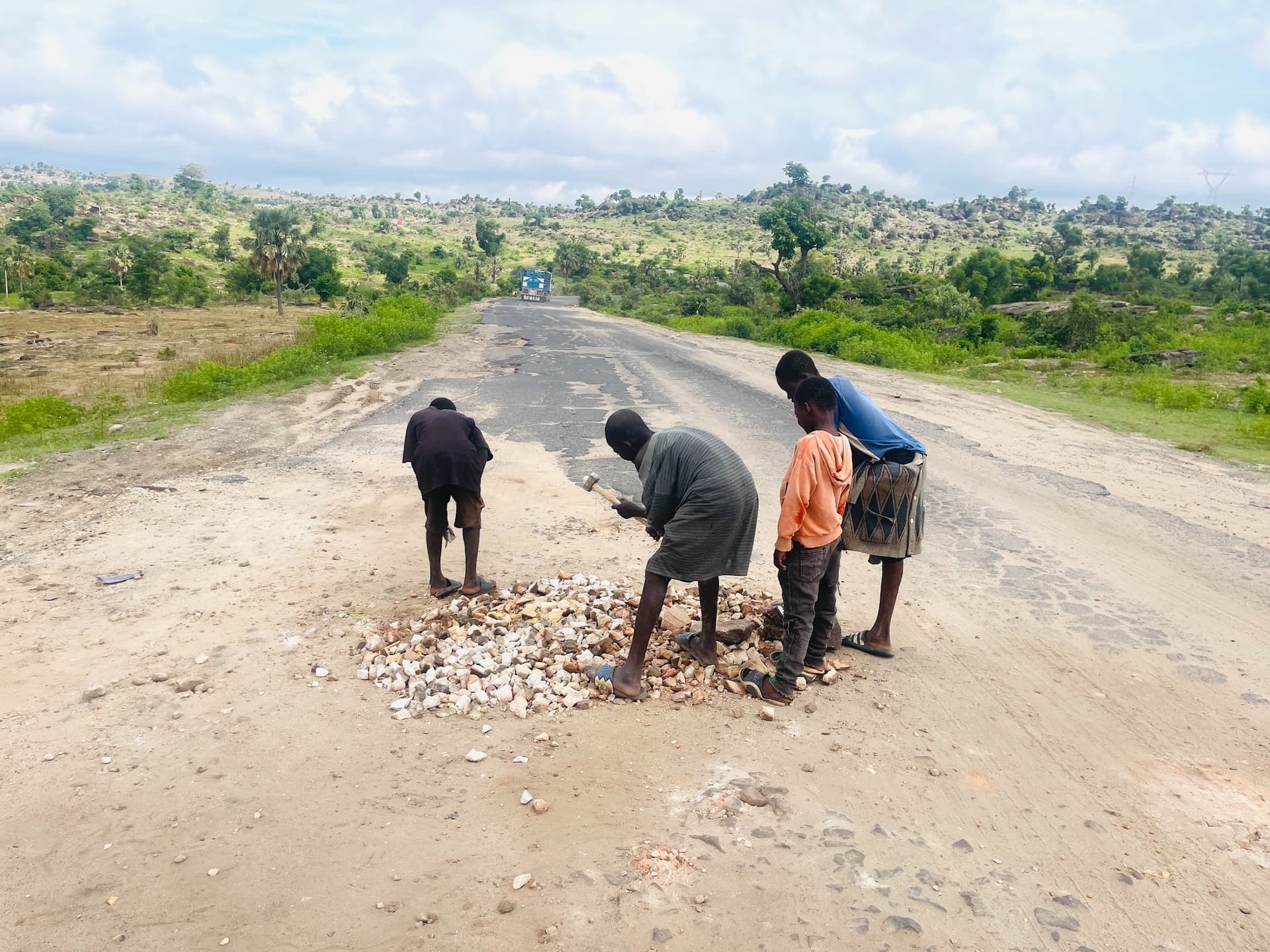
Along the Adamawa-Gombe highway, in northeastern Nigeria, women and children are striving to survive. They fill potholes with broken rocks and, in return, receive tokens from drivers and other commuters. There are risks, however.
Listen to this story

14 Aug 2026
Rauta Ishaya said there was almost no job she didn’t do to survive that year. It was 2018, and her husband had just passed away, leaving her behind with nine young children to feed. She said she was constantly on the edge, trying new businesses and doing all kinds of jobs to earn an income. However, it was not enough.
The 40-year-old widow told HumAngle that feeding her children and paying their school fees after her husband died left her so overwhelmed that she would always go to bed crying.
One day in 2018, Rauta decided to try something new. A kind of hustle that, unknown to her, would later transform her life and hundreds of others in her community, Yolde, in the Cham area of Balanga Local Government Area, northeastern Nigeria.
‘Chairlady of the tarred road’
“I wiped my tears one day, entered my room, and brought out my hammer,” Rauta recounted.
Over the years, she had seen vehicles get stuck along the road close to where she resides. “Motorcycle riders were constantly falling. Accidents were so common, and people were dying around the road.”
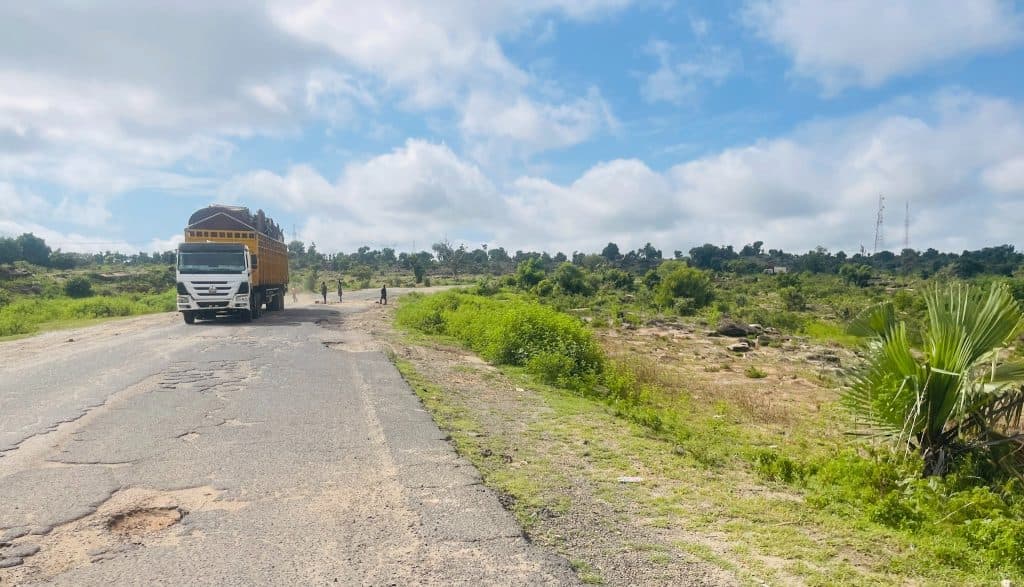
The Cham-Numan section of the Gombe-Yola highway is the major route that connects travellers from Adamawa to Gombe from the country’s southern region and parts of the North Central and Bauchi State. Every day, goods are loaded onto heavy-duty trucks and transported from Adamawa through Gombe to other states. Travellers from Gombe and other parts of northeastern Nigeria, like Bauchi and Borno, also utilise the highway to reach Adamawa.
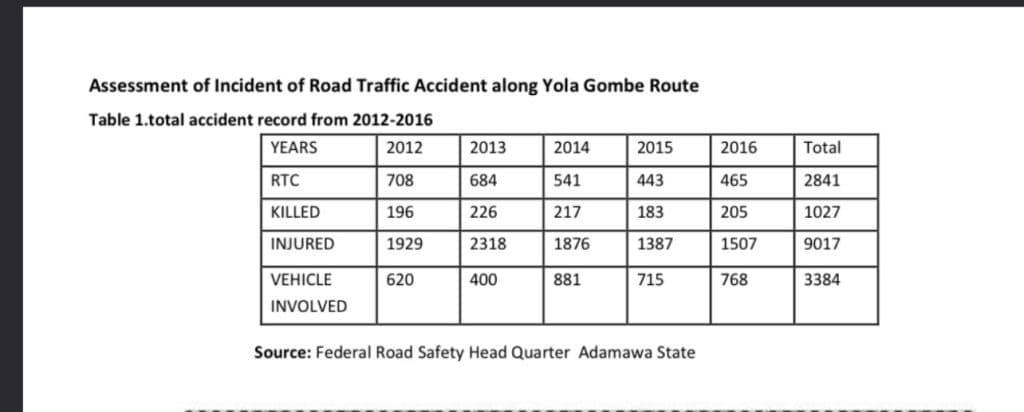
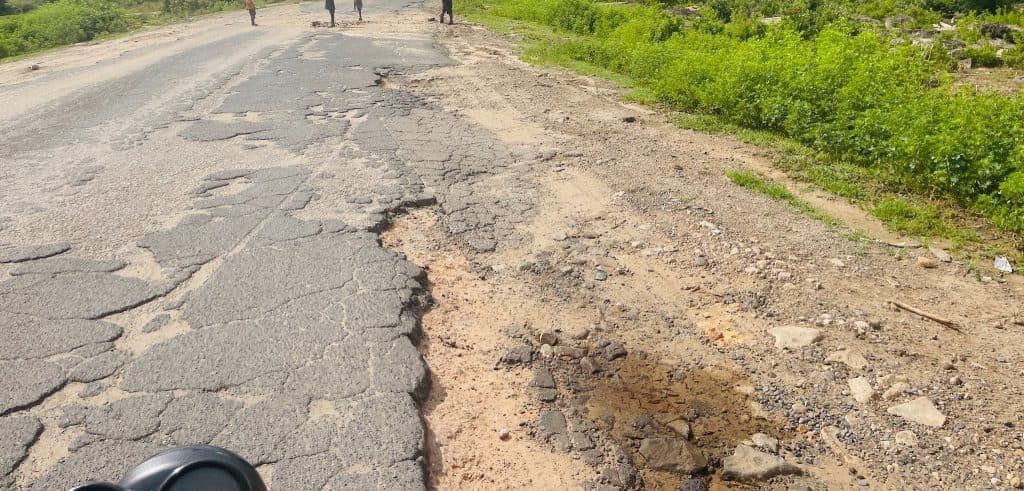
That stretch of the road is dilapidated; the coal tar has washed away, leaving behind bumps. A 2021 assessment by the Office of the Adamawa State Surveyor General stated that road traffic accidents along the road witnessed over 2800 accidents between 2012 and 2016. Of these incidents, 1027 people died, while more than 9000 sustained varying degrees of injury.
The responsibility for maintaining and rehabilitating federal highways in Nigeria lies primarily with the Federal Ministry of Works, which oversees the construction, rehabilitation, and maintenance of Trunk A roads across the country. The Federal Roads Maintenance Agency (FERMA) is also mandated to carry out routine and emergency maintenance interventions on federal roads, including addressing potholes and other road defects. However, the dilapidated state of several roads across the country shows that they have not been efficient.
Rauta realised that the bad state of the road was the major cause of recurring accidents, so when she picked up her hammer that day in 2018, she was determined to make a change and possibly earn from it.
The next day, she went into the bush where there were large deposits of rocks. She broke one down into smaller pieces, collected them in a container, and returned to the highway, where she poured the stones into a pothole. A driver who was carrying goods to Gombe town that morning saw her and dropped a token.
“I can’t remember how much the first driver gave me, but I made a total of ₦300 by the end of that day, and back then, it was such a big amount, especially since I didn’t have a dime,” she recalled with a smile.
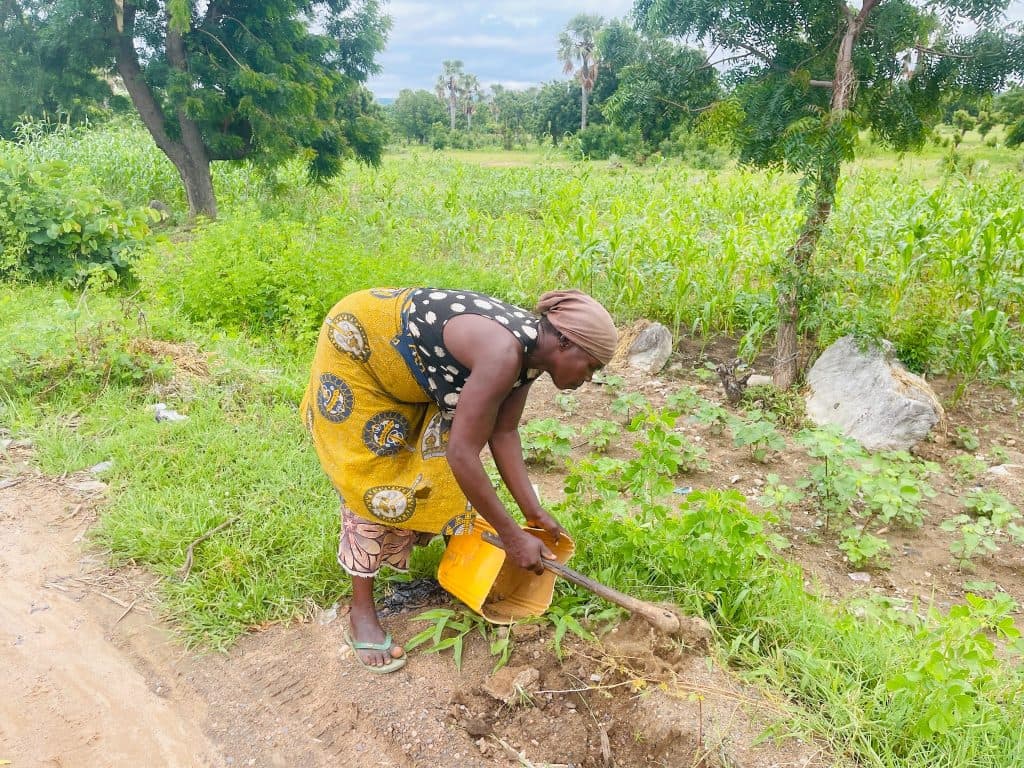
The following day, Rauta went out again, broke down more rocks into gravel, and filled more potholes on the highway. When she came across a pothole that needed just sand filling, she fetched some from the bushes and poured it into the hole. Drivers and motorcycle riders who saw her dropped tips. She made a total of ₦700 on the second day.
“I felt rich that day,” she chuckled. “So I went and bought maize and ground it, then bought Maggi and salt, and cooked for my children that evening. I rested and returned some days later.”
Locals affirmed that Rauta was the first person to raise a hammer and split a rock to fill potholes along the highway. They refer to her as the chairlady na yan kolta, a Hausa phrase that means, ‘chairlady of the tarred road’.
As time went by, more women began to join Rauta to fill potholes on the highway. Within months, their numbers doubled, with widows making up the majority. Now, there are about a hundred of them making a living from the craft. One of them is Rebecca Kodum.
Of misinformation
Not everyone understands that these women go to the road every day to make repairs and earn some money. In a viral video shared on X in May, a woman was breaking rocks into a pothole along the Gombe-Yola highway, but the comments on the post suggest that she was carrying out an act of vandalism. Some even accused her of consciously creating barriers that would enable armed robbers and terrorists. The video was viewed at least 260,000 times, and many of the comments made accusations about her intent and even action. However, the woman is one of the pothole fillers in Yolde.

‘It is better than stealing’
Rebecca arrived in the Yolde community from Kaduna State in 2023 after her husband’s death.
“I am from Kaduna. My husband died, so I decided to come back with my children here. He [her husband] is from Cham,” she said.
As time went by, Rebecca realised that survival was becoming increasingly difficult for her and her children. She noticed that the women of Yolde would go out every morning carrying hammers, buckets, and other stone-breaking equipment. She spoke to some of them, who explained the pothole-filling work to her, and soon she joined them.
“I have been doing this work for more than two years now,” the 54-year-old said. So far, she said the work has enabled her to put food on her family’s table. On a good day, she makes about ₦7,000, while on other days, she earns less. Rebecca works at least five times a week.
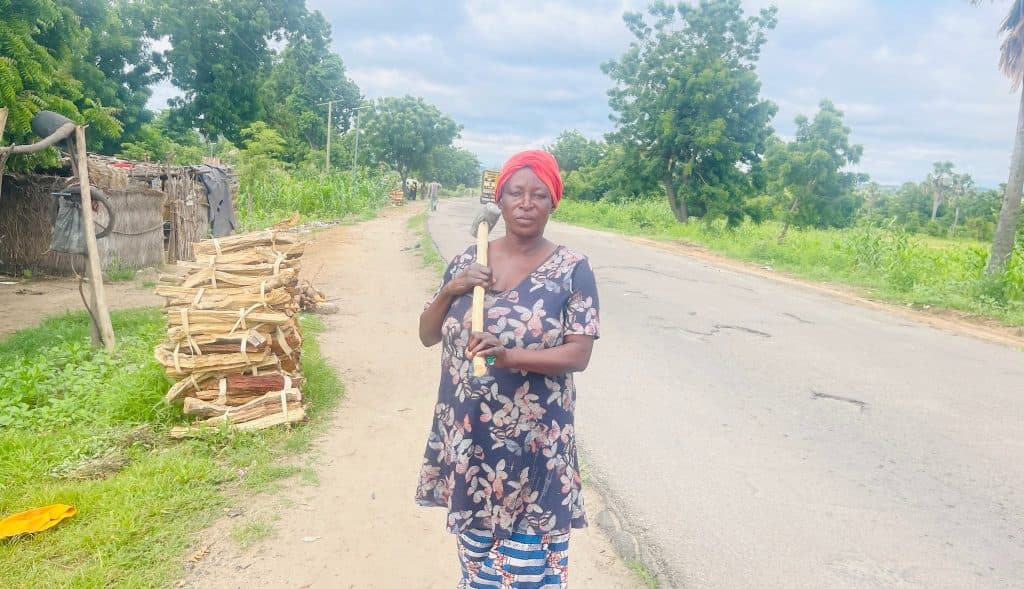
While some women skip a day or two due to the hard nature of the work, others show up daily; a majority of them are widows, but a few married women and children also join on some days.
“I would rather do this work than beg or steal,” one of the women told HumAngle.
For most of them, their walk to the roadside starts by 6 a.m., when drivers have started plying the route. They then head into the bush, where rocks and stones are plentiful. Since Yolde is a rocky area, the women say they do not have to travel far to collect rocks for breaking. Sometimes, they carry the larger stones on their head or roll them closer to the highway before breaking them into smaller pieces.
When they come across sections of the road that require softer filling, they fetch sand and spread it into the potholes to create a more even surface.
Lately, the women say they have had to walk longer distances, sometimes for hours, looking for potholes to fix, since they have filled most of the ones closer to their homes. They leave home with large water bottles and food because they mostly return by evening. By the roadside, they rest, eat, and sometimes sleep when they are exhausted.
Rauta, who heads the group, said the women have covered access roads that stretch into Adamawa and Gombe communities. From the Lafiya/Lamurde road to Yadi, then to Kwanan Saje, they filled potholes down to the main Cham community that leads into Gombe town.
The women said they receive more tips from truck drivers and those who drive heavy-duty vehicles because their vehicles benefit the most from the repairs. Even though the work is strenuous and risky, the women believe their work is significant to humanity. They say accident rates have gone down, especially among motorcyclists who regularly ply those routes.
“Sometimes, it is not just about money,” Rauta said. “Some of these drivers park their vehicles, come to us, and salute us. This makes us feel valuable.”
Even though the work helps them support their families alongside other petty businesses, Rauta said manually filling potholes cannot entirely transform the road. “My wish is that the government should fix this road because people are dying. People are still having accidents by falling off motorcycles, cars, and trucks. People are always losing their lives and properties. Even though we get money here, the government should fix the road because people’s lives and properties are being wasted here. Fixing this road will not make me feel bad because we all want something good,” she added.
Similarly, drivers have also called on the government to ensure the highway is fixed. “The potholes are the reason why the brakes fail, and cars get heated, especially during the hot season, but if the roads were good and smooth, it wouldn’t happen,” Abdullahi Umar, a driver who has used the route for over two decades, said.
Teenagers and children across Yolde have also joined the hustle. Some of them said they followed their mothers to the highway, where they observed, learned, and mastered the work. Japheth Manasseh is one of them. The 16-year-old, who has been doing the work for over a year now, explained that he comes to the site to fill potholes whenever he closes from school. During the holidays, his group works from dusk to dawn.
“Sometimes, we make ₦1000 each daily from the tips, but sometimes, it’s less,” he added.
Japheth noted that his group is always careful. Whenever a vehicle approaches, they leave the highway and stand by the roadside. Some drivers wind down their windows and throw money to them. “I use the money to buy things for myself,” Japheth said.
Although many of the women are farmers, some said the rocky nature of the area makes certain types of farming difficult. Some own farms in more suitable locations, including more fertile areas and highlands where crops can thrive, but farming often requires waiting months before harvest, and only then can income be realised. Pothole filling, by contrast, provides immediate returns, as drivers and commuters give them money each day for their work.
A local resident told HumAngle that some women gradually abandoned farming after pothole-filling became popular because it offered a quicker source of income than agriculture.
‘They are helping us a lot’ – Drivers
HumAngle spoke to some motorists who constantly ply the Cham-Numan route. Abdullahi Umar is one of them. The driver has been transporting passengers and goods between Numan and Gombe Town for about 20 years. He explained that until the women started filling the potholes, accidents were very common, but the repairs have since improved the roads and made movement easier. He spoke with praise for the women.
“The women and children doing this work have been doing it for about 10 years now. The children and their siblings, which you see here, have been following their parents when they were very young, but now probably some of the parents are now old and tired while some are dead so they [children] are now the ones mainly doing the work,” the driver said.
While commending the women for their hard work, Abdullahi added that he often sees them at around 6 a.m. when taking passengers from Numan to Gombe. He usually encounters the same group again at about 5 p.m. on his return journey to Adamawa.
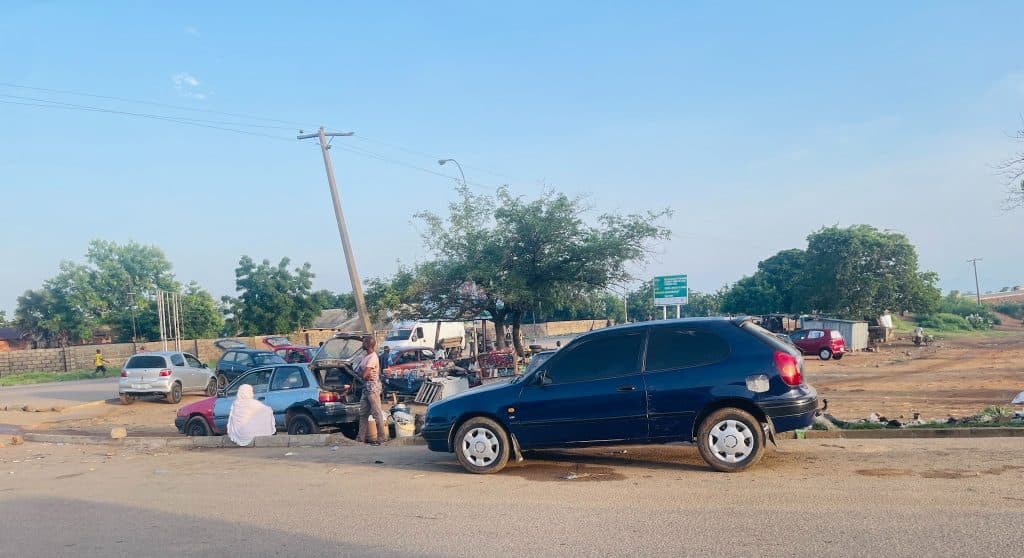
“They are helping us a lot,” he said. “We can’t pass without giving them money. If we don’t give them anything on our way to Gombe, we give them something on our way back so they can support themselves and their children.”
Abudullahi noted the pothole-filling work is quite risky, as there have been instances of some women being hit by vehicles while working on the road. “When they see a car coming at speed from afar, they run in case the brakes might fail. Some drivers even yell at them from afar to move away when their brakes are about to fail,” he stated, noting that these were some of the strategies utilised to keep the women and children safe on the highway.
Bearing the risks
A few months after she started filling potholes along the Cham highway, Rauta said she was hit by a vehicle. “I sustained an injury at the corner of my eye that time, and my body ached for weeks,” she recalled.
Rauta said when she returned to the highway a few days after recovering, some community members taunted her. “Some said the work was not honourable. Some said I was worse than a beggar. But it’s honest work, and I had responsibilities, so I didn’t listen to them,” she added.
When more people joined her on the highway months later to also fill the potholes, Rauta was surprised because among them were the same people who criticised her. However, she’s glad they realised there was dignity in labour.
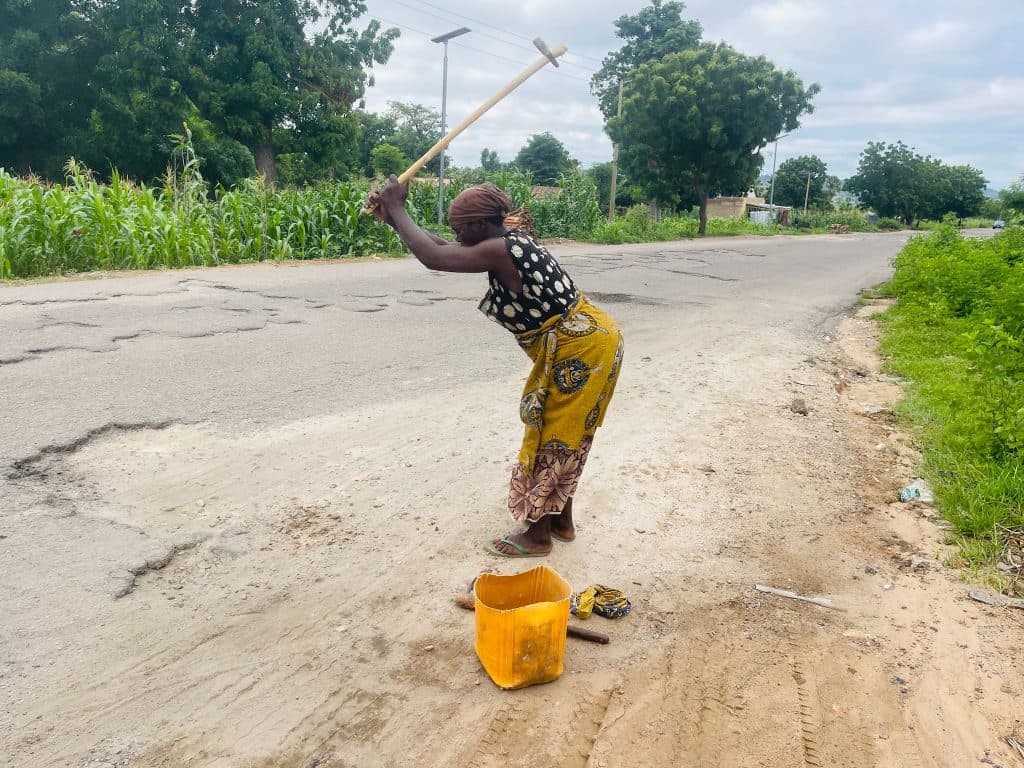
The risks of the work have not stopped, she said, “I’ve crushed my fingers several times when trying to break the stones into smaller pieces.”
Other women told HumAngle that fatigue is something they always battle with after the day. For Rebecca, the downside of the pothole filling craft is reflected in her aching legs. She currently limps while walking, and she said the condition worsened this year.
“Sometimes, I stand on the highway for six hours breaking the stones into these potholes and even when I’m done, I’ll remain there so the drivers can notice me and tip me. Standing for too long has affected my legs. Also, lifting a hammer as big as this is not easy. I return home and ache all over every evening,” Rebecca said.
The women say they rely on self-medication with painkillers like paracetamol whenever they return home. “I am suffering from back pain and knee pain because I stand all day. I have been doing it for eight years. Anytime I go home from work, I must take paracetamol,” Rauta stated.
Failed promises
The women’s efforts have unfolded amid years of delayed rehabilitation on the highway. In 2017, the road was awarded for ₦9 billion to Messrs CGC (Nigeria) Limited, but work on the highway has only partially progressed despite nearly a decade having passed since the award. Recently, the Federal Ministry of Works visited the Cham-Numan section of the Gombe-Yola Road.
During the visit, Dimas Tuwai, the Federal Controller of Works for Adamawa State, blamed inflation and other contractual factors, which have now increased the project’s cost from the initial ₦9 billion to ₦43 billion. He claimed that the project was 44 per cent complete, with about 13 kilometres remaining, which he said would be completed within the year.
According to GovSpend, a platform that tracks and analyses federal government spending, about ₦226,190,476 was paid to Messrs CGC Nigeria Limited in October 2019 by the Federal Ministry of Power as part payment for the rehabilitation of the Cham-Numan section of the Gombe-Yola Road in Adamawa State. Further records from EARMARK, a government-run digital platform tracking federal infrastructure projects, show that the rehabilitation project (Project Code: ERGP12131316) was domiciled under the Federal Ministry of Works and Housing, with a total appropriation of ₦473,755,716 and an annual appropriation of the same amount in 2019. The project was listed as ongoing. However, residents say little has been done.
“CGC is committed to completing this project, and we assure you we will meet the stipulated deadline,” said Simeon Omale, spokesperson for Messrs CGC (Nigeria) Limited.
While waiting for the government to do its part, the women of Yolde say they will return to the highway at the crack of dawn because it is there that they earn their daily bread.
Support Our Journalism
There are millions of ordinary people affected by conflict in Africa whose stories are missing in the mainstream media. HumAngle is determined to tell those challenging and under-reported stories, hoping that the people impacted by these conflicts will find the safety and security they deserve.
To ensure that we continue to provide public service coverage, we have a small favour to ask you. We want you to be part of our journalistic endeavour by contributing a token to us.
Your donation will further promote a robust, free, and independent media.
Comments
0 comments
No comments yet.
Sign in to join the discussion.
Of course, we want our exclusive stories to reach as many people as possible and would appreciate it if you republish them. We only ask that you properly attribute to HumAngle, generally including the author's name, a link to the publication and a line of acknowledgement.