Frequent Budget Violations, Favouritism … Other Allegations Against Suspended EFCC Boss
Listen to this story

8 Jul 2020
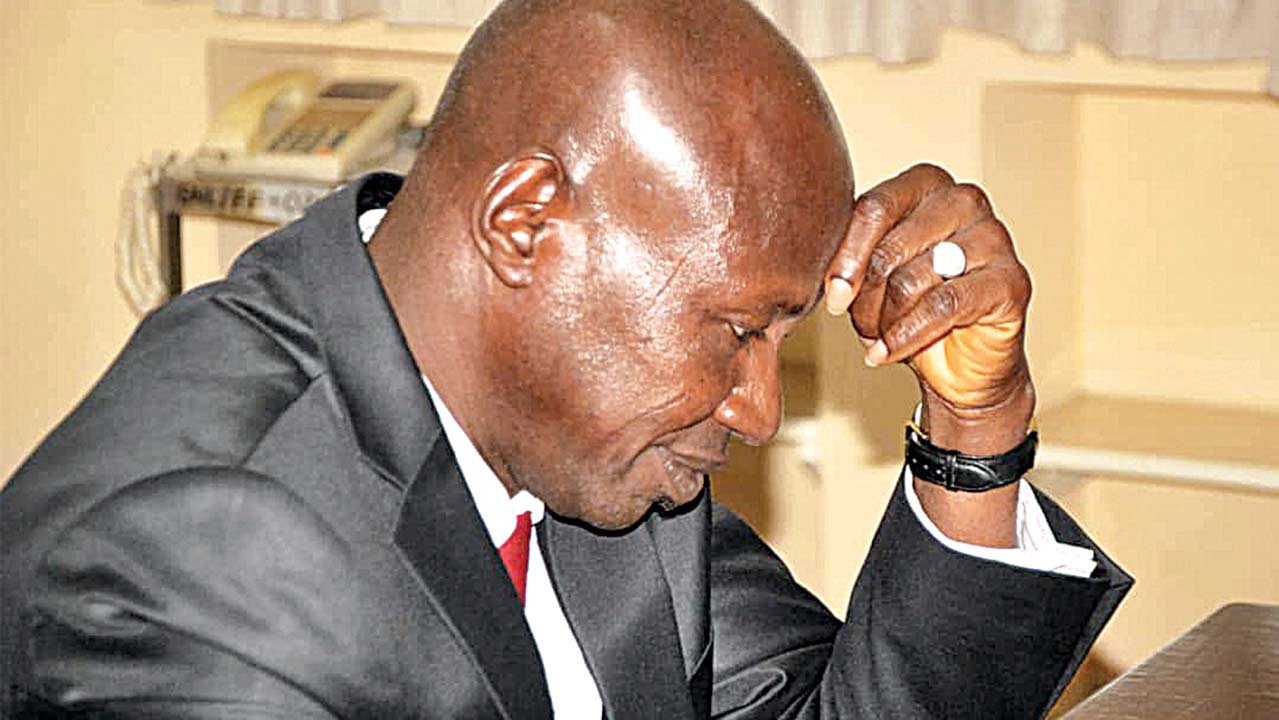
Acting Chairman of the Economic and Financial Crimes Commission (EFCC), Ibrahim Magu, who was suspended on Tuesday, habitually violated the commission’s budgetary limits, was financially reckless, and abused his office in favour of his cronies, HumAngle has learnt.
Magu was arrested on Monday by operatives of the Department of State Services (DSS) and the Nigeria Police weeks after the Attorney-General of the Federation, Abubakar Malami, recommended his sack based on allegations of corruption, accounting gaps, unlawful diversion of recovered assets, and insubordination.
In total, there are “22 weighty allegations” against the acting chairman in Malami’s memo to President Muhammadu Buhari.
Magu has remained in detention since his arrest and is being interrogated. Security operatives combed his residences at Karu and Maitama District, Abuja, on Tuesday for incriminating materials. Sources at the DSS and EFCC, however, informed this paper that the indicted EFCC boss had the houses tidied up before the searches were conducted. Some of the officials involved in the exercise are still at large.
Many irregularities have allegedly taken place under Magu’a administration since his appointment in 2015, including “deliberate non-compliance with budgetary provisions” and public procurement rules.
A senior official at EFCC told HumAngle that although funds were released to the commission for the purchase of furniture items for its new head office launched in 2018, Magu released a circular directing the staff to relocate along with their old office furniture “despite several complaints about their dilapidated conditions”.
“A visit to the EFCC head office complex will confirm these facts,” the source said.
A look through the 2019 approved budget shows that N449 million was allocated for the “purchase of office furniture and fittings for the new head office” and N65.4 million was allocated for new furniture at zonal offices in Abuja and other places.
According to the source, Magu single-handedly ordered the opening of four new offices in Benue, Kwara, Nasarawa, and Sokoto states without approval or budget allocation “for the purpose of political vendetta”. As a result, these additional offices were underfunded and underequipped.
The EFCC senior official said Magu was the de facto director of the commission’s Procurement Department which regularly disregarded the 2007 Public Procurement Act.
“In most instances, contracts were awarded under the guise of selective tendering and were inflated or a substandard job would be executed. Actual documentation would be backdated and when the former Director of the unit, Mr M.T. Ibrahim, advised against such practices he was dealt with seriously,” the source said.
Referring to it as Magugate, the source also raised concerns about possible mismanagement of security votes allocated to the suspended chairman and the fabrication of retired documents.
Security votes approved for the office between 2015 and 2019 totalled N736.6 million: N153 million in 2015, N170 million (2016), N150 million (2017), N170 million (2018), and N93.6 million (2019).
According to Transparency International, “Security votes are opaque corruption-prone security funding mechanisms widely used by Nigerian officials.”
“A relic of military rule, these funds are provided to certain federal, state and local government officials to disburse at their discretion. In theory, they are reserved for covering unforeseen security needs,” it stated in a 2018 report.
“Transacted mostly in cash, security vote spending is not subject to legislative oversight or independent audit because of its ostensibly sensitive nature. Although officials often spend some of these funds on security, they also channel them into political activities or embezzle them outright.”
The top EFCC source said in-house prosecution lawyers often paid for court fees at their personal expense. The lawyers and investigators also often had to arrange their transportation to court by themselves “thereby creating avenues for compromises”.
Magu was also accused of favouring officers on secondment at the EFCC from the Nigeria Police Force. These officers are about 5,600 and include senior officers, drivers, armourers, mobile policemen, and so on.
Some of these policemen, known as “Magu’s boys”, were alleged to have been seconded without due process and to have compromised high-profile investigations and prosecution.
Under his administration, it was alleged, the EFCC was over-dependent on the Nigeria Police for manpower, vehicles, and weapons.
Sources said that the absence of checks and balances in the administration of the commission could be traced to the non-constitution of a board as provided under section 2 of the EFCC Establishment Act of 2004.
Here are the allegations made against the suspended EFCC boss:
Support Our Journalism
There are millions of ordinary people affected by conflict in Africa whose stories are missing in the mainstream media. HumAngle is determined to tell those challenging and under-reported stories, hoping that the people impacted by these conflicts will find the safety and security they deserve.
To ensure that we continue to provide public service coverage, we have a small favour to ask you. We want you to be part of our journalistic endeavour by contributing a token to us.
Your donation will further promote a robust, free, and independent media.
Comments
0 comments
No comments yet.
Sign in to join the discussion.
Of course, we want our exclusive stories to reach as many people as possible and would appreciate it if you republish them. We only ask that you properly attribute to HumAngle, generally including the author's name, a link to the publication and a line of acknowledgement.